


Starting July 4, 2026, you can fund a new kind of account for a child. The headlines call them “Trump Accounts.” Last year’s tax law created them, and the pitch is a starter retirement account for kids. The questions are pouring in. Is it free money? Is it better than a 529? Should I open one for my newborn? Here is the honest version, because the marketing and the math do not always agree.
The big thing to know up front is that the saving matters far more than the account you save in. A child whose family sets money aside early will do well in a Trump Account, a 529, or a plain taxable account. The government keeps rolling out new ways to save for kids, custodial Roth IRAs, 529 plans, and now Trump Accounts, but none of them is one-size-fits-all. What you are trying to provide for your child, and when they will need it, shapes the answer more than the name on the statement. So the real question is not “should I use the new account,” it is “what am I saving for, and which account fits that goal.” Let’s walk through it.
First, what is a Trump Account?
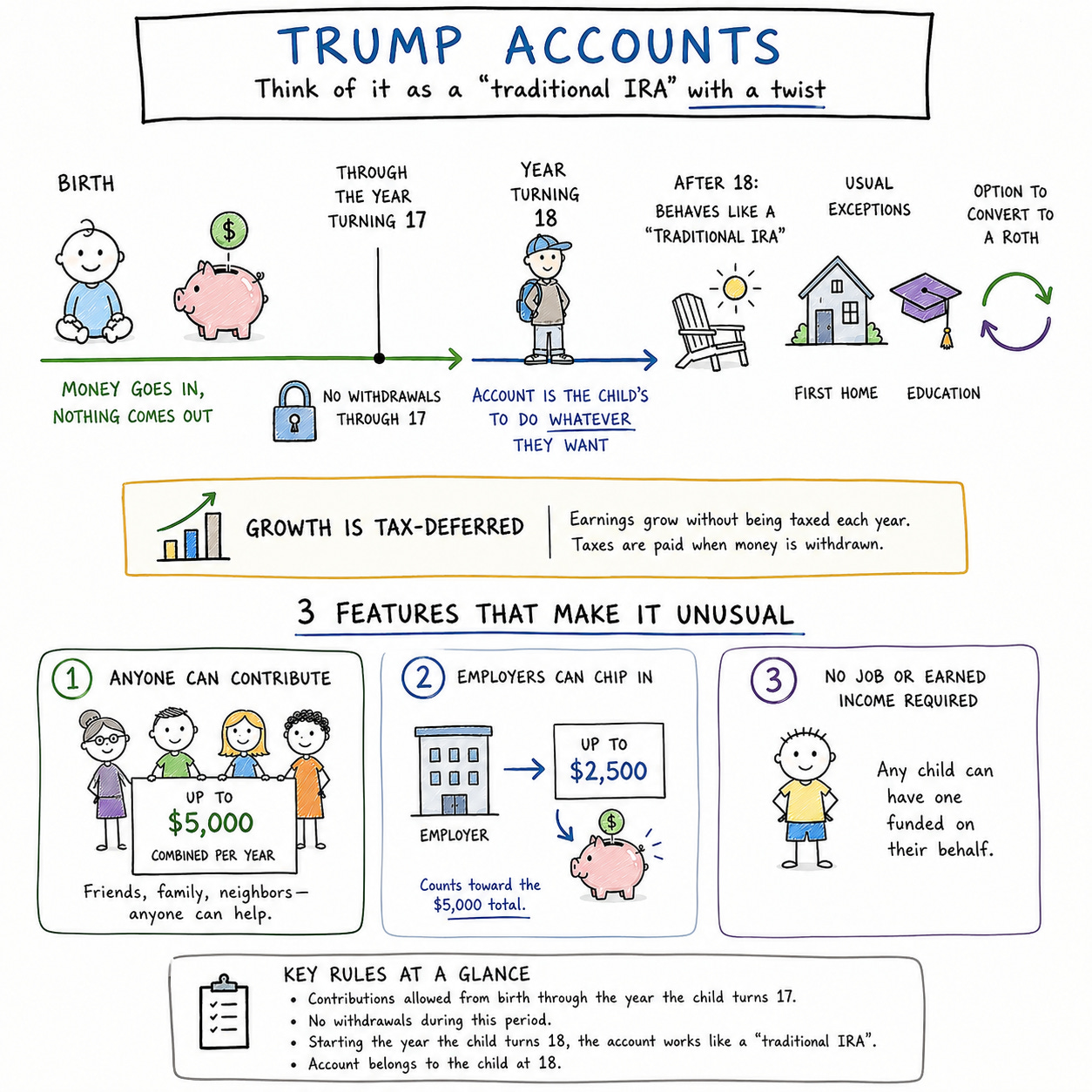
Think of it as a traditional IRA with a twist. You can open and fund it for a child from birth through the year they turn 17. During that window, money goes in but nothing comes out. Starting the year the child turns 18, it behaves like a normal IRA: penalty-free withdrawals at 59½, the usual exceptions for things like a first home or education, and the option to convert to a Roth.
Three features make it unusual. Anyone can contribute, up to a combined $5,000 a year. Employers can chip in up to $2,500 of that. And unlike a regular IRA, the child does not need a job or earned income to have one funded on their behalf.
Is the $1,000 really free?
Yes, but here is where people get tangled up. Eligibility and the $1,000 are two different things. Any U.S. citizen child with a Social Security number can have a Trump Account opened for them, at any age under 18. The $1,000 is narrower. The government only seeds accounts for children born between 2025 and 2028. So your older kids can still have an account, they just will not get the free deposit.
The seed itself is simple. It does not count against any contribution limit, and you do not have to match it. You do have to claim it, by filing Form 4547 or signing up at trumpaccounts.gov.
On top of that, some employers and a handful of charities are funding accounts too. If any of that is available to your family, take it. Money that compounds untouched for decades is worth claiming, full stop.
What about putting in my own money?
Here is where the shine comes off a little, and where most of the questions get interesting.
A Trump Account grows entirely tax-deferred, which sounds great until you remember the bill comes due later. Every dollar of growth eventually comes out taxed as ordinary income, at whatever rate your child pays decades from now. Fund one aggressively from birth and you could hand your kid a seven-figure pre-tax account by retirement. That is the same tax knot we spend our days helping older clients untangle from their large IRAs and 401(k)s. A good problem to have, but a problem.
There are two quieter traps worth naming.
The first is basis tracking. The dollars you contribute are after-tax, so they should come back out tax-free someday. But proving that means filing the right form every single year, potentially for 40 years or more, across a handoff from you to your adult child. Miss it, and the IRS treats the entire withdrawal as taxable. People lose track of IRA basis all the time, and this account stretches that risk over a lifetime.
The second is the Roth conversion dream. The popular idea is to convert the account to a tax-free Roth when your child turns 18 and has little income. The catch is the “kiddie tax.” For a dependent child, income above a small threshold gets taxed at the parents’ rate, not the child’s. So a college student with high-earning parents cannot quietly convert a big balance at a 0% rate. They usually have to wait until they are out of school and earning on their own, by which point they are converting at regular rates anyway.
Trump Account vs. 529 vs. custodial account: which one wins?
This is the question we hear most, and the honest answer is that it depends on your family. That is not a dodge, it is the whole point. Two households with the same income and the same age kid can land on completely different accounts, because they want different things for those kids.
If you are saving for college, a 529 is still the better tool. It is built for education, and it can roll up to $35,000 into a Roth IRA completely tax-free, something the Trump Account cannot match.
If you want flexibility, a plain taxable custodial account, a UTMA or UGMA, is hard to beat. Our friends at Kitces ran the full after-tax math on this, and the result surprises people. A taxable account can actually end up worth more than a Trump Account after taxes, because gains can be harvested at a 0% rate while the child is young, and the account gets a step-up in basis if it is ever inherited. It is also far more flexible. The money can be used at any age, for a home, a business, or anything else, instead of being locked up until 59½. The tradeoff is that a custodial account counts as the child’s asset for financial aid, which can reduce need-based aid, so it is not right for every family.
And if your child has earned income, even from a summer job, a custodial Roth IRA is often the most powerful option of all.
So what should you actually do?
For almost everyone, the first move is the same. Grab the free money. Claim the $1,000 if your child qualifies, and accept any employer or charitable contributions on offer. That decision is easy.
The harder decision, putting your own money in, deserves a real conversation rather than a reflex. Sometimes a Trump Account is the right home, especially for families who have already funded college and want another tax-advantaged way to pass wealth to the next generation. Often a 529 or a custodial account fits the goal better.
One human thing sneaks up on people too. A well-funded account becomes your child’s to control at 18. That is a conversation to start early, not a surprise to spring at a graduation party.
The bottom line
Trump Accounts are a real opportunity wrapped in a lot of hype. The free money is genuinely free and worth claiming. Beyond that, the new account is one good tool among several, not an automatic upgrade. The government will probably keep inventing new ones, and that is fine. There is no single right account, only the right account for what you want to give your child and when. What matters most is starting early, in whatever vehicle fits that goal.
If you have a child or grandchild and you are trying to figure out the right move, that is exactly the kind of question we like. If you already work with us, reply and we will fold it into your plan.