


My grandfather claimed Social Security at 62. He died at 92.
I did the math last year for fun (and because I have a problem), and leaving aside inflation adjustments and the time value of money, he left somewhere north of $150,000 on the table. Poof. Gone. Not because he was irresponsible or uninformed. He did what almost everyone does: took the money when the government offered it and figured that was probably fine.
Every other income-generating asset in the world gets cheaper or more expensive based on where interest rates are. Social Security doesn’t care. That asymmetry is insane. And it almost entirely favors the people who wait.
He was wrong. And so is basically everyone who gives you the same advice.
Here’s what nobody explains clearly: when to claim Social Security is not a guessing game about how long you’ll live. It’s not really even a personal finance question. It’s a fixed income allocation decision. And when you look at it that way, the math gets almost embarrassing in how lopsided it is.

The Break Even Nobody Talks About
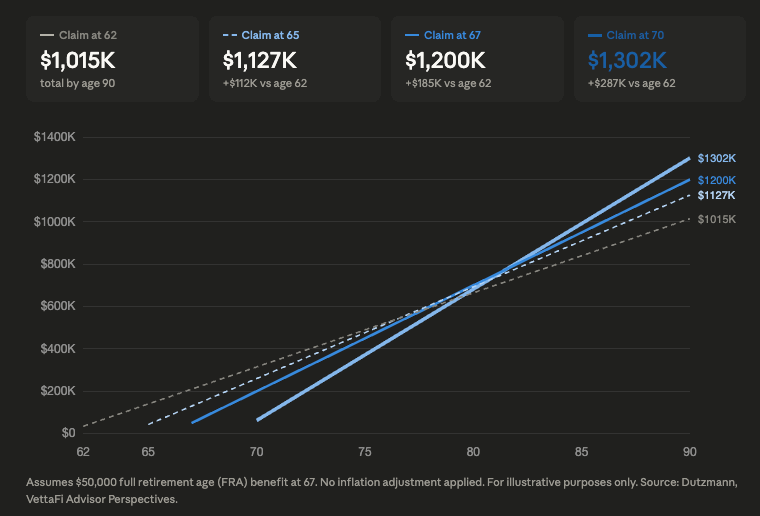
Most financial advisors, when they explain Social Security timing, reach for something called the “breakeven age.” The idea is simple: if you claim early (as young as 62), you get smaller checks for longer. If you delay (up to age 70), you get bigger checks starting later. At some point the cumulative totals cross over. That crossover is the breakeven.
To make early claiming the smart move, your portfolio needs to beat what the government is guaranteeing you by 2.5 to 4.5 percentage points, every single year, for the rest of your life. That’s not a return expectation. That’s a prayer.
For most people, the break even age is somewhere in the early-to-mid 80s.
The conversation usually stops there. “If you live past 83, delaying wins. If you die earlier, claiming early wins.” This sounds reasonable. It’s also the wrong frame.
The right question isn’t “when do I break even?” It’s “what would I have to earn on my portfolio to match what I get from delaying?”
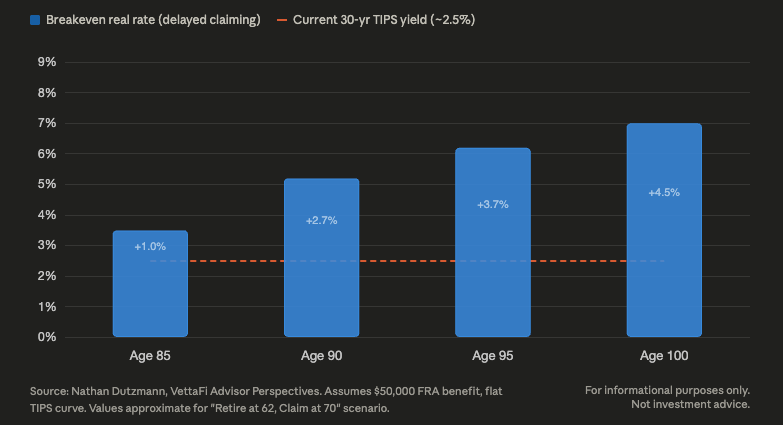
Researchers have started calling this the breakeven real rate, the inflation-adjusted return your investments would need to generate, every single year, to produce the same real income as if you had simply waited to claim Social Security.
Here’s where it gets uncomfortable.
For anyone planning to live to 90 (not an unreasonable target if you’re reading this in your 50s or 60s and in reasonable health), the breakeven real rate, the hurdle your portfolio has to clear, is roughly 5% to 7% above inflation.
Current 30-year TIPS yields sit around 2.5%.
In plain English: to make early claiming the smart financial move, your portfolio would need to outperform what the government is essentially guaranteeing you by 2.5 to 4.5 percentage points, every year, for the rest of your life. That’s not a return expectation. That’s a prayer.
The Interest Rate Quirk That Should Make Your Brain Hurt
Here’s the thing about Social Security that is genuinely weird, and I mean this in the nerdiest possible way.
Almost every income-generating asset in the world is priced based on prevailing interest rates. When rates are high, bonds and annuities pay more. When rates are low, you pay more to get the same income stream. Supply, demand, discount rates, the whole apparatus.
Social Security doesn’t work that way.
The step-up you get for delaying (roughly 6-8% more annual income per year you wait) is fixed. It doesn’t move when the Fed cuts or hikes. It doesn’t respond to Treasury yields. The government says “wait one year, get 8% more forever,” and that number is the same whether we’re in a 2% rate environment or a 6% rate environment.
What this means practically: the lower rates go, the better delaying looks relative to every alternative. Because every alternative is offering less. Government bonds are less compelling. Annuities are more expensive to purchase. And Social Security is sitting there with the same fixed 8% step-up, looking increasingly like the best deal in fixed income.
Nobody building an annuity product or a bond ladder can price their offering without knowing where rates are. Social Security doesn’t have to care. And it almost entirely favors the people who wait.
Who Benefits Most (And It’s Probably Not Who You Think)
The break even analysis changes based on who you are, and a few things stand out.
Women benefit more than men. This isn’t complicated. Women live longer on average, so the longevity hedge that comes with a larger Social Security check is worth more. Social Security’s formula ignores this actuarial reality entirely. It charges everyone the same price for delayed benefits. Women are getting a relative bargain.
The higher earner in a married couple benefits most of all. When a spouse dies, the surviving partner inherits the higher of the two Social Security checks. Whichever earner waited longer and built the bigger monthly benefit essentially locks in a larger lifetime income floor for the household, because one of those checks is going to be paid out for a very, very long time.
The first year after full retirement age (FRA) is disproportionately valuable. This is the one most people miss. Social Security’s step-up structure actually makes the jump from FRA to FRA+1 more valuable in percentage terms than later years. The 8% per year figure sounds linear, but it’s 8% of your full retirement benefit amount, which means as a percentage of what you’d actually be collecting each year you wait, the relative gain shrinks slightly over time. Year one after FRA punches above its weight. If you’re on the fence and close to your full retirement age, that year is probably worth the wait.
The Part That Has Nothing to Do With Math
Here’s what breakeven rates and portfolio return assumptions can’t capture: Social Security is the only retirement income stream that simultaneously hedges both inflation and longevity. That combination is genuinely rare. You can build a TIPS ladder that protects against inflation. You can buy an annuity that protects against outliving your money. You cannot easily find something that does both at scale without either enormous expense or meaningful credit risk.
A bigger Social Security check, locked in for life, adjusted for inflation every year, with no counterparty risk, is a different category of asset than anything your brokerage account holds. The question isn’t “do I need the income now?” The question is “how much of my retirement floor do I want protected against the two things that most commonly wreck retirement cash flow plans?”
Every year you delay is essentially buying more of that protection at a price the market could never match.
What To Actually Do With This
None of this means everyone should delay to 70. There are situations where claiming earlier makes sense: known health issues that reduce life expectancy, immediate cash flow needs that can’t be covered otherwise, complex spousal benefit timing that creates a different optimal strategy. This stuff is genuinely situation-specific.
But if you’re sitting here in reasonably good health with a financial plan that doesn’t require Social Security income to survive between 62 and 70, the default bias should be to wait. The math says so. The interest rate environment says so. The longevity hedge says so.
The instinct to grab the money while you can is human. It’s also expensive.
My grandfather took his check the first day he could. He had 29 more years to live with the consequences of that decision. I’m not going to make the same call. And if you’re a client reading this and haven’t run your own Social Security scenario yet, that conversation is overdue.
Social Security claiming decisions involve complex individual factors including health, income needs, spousal benefits, and tax implications. Iconoclastic Capital Management is an SEC-registered investment adviser. This content is for informational purposes only and does not constitute tax or legal advice. Please consult a qualified advisor regarding your specific situation.
I’m just operating under the assumption I’ll need to work until I die